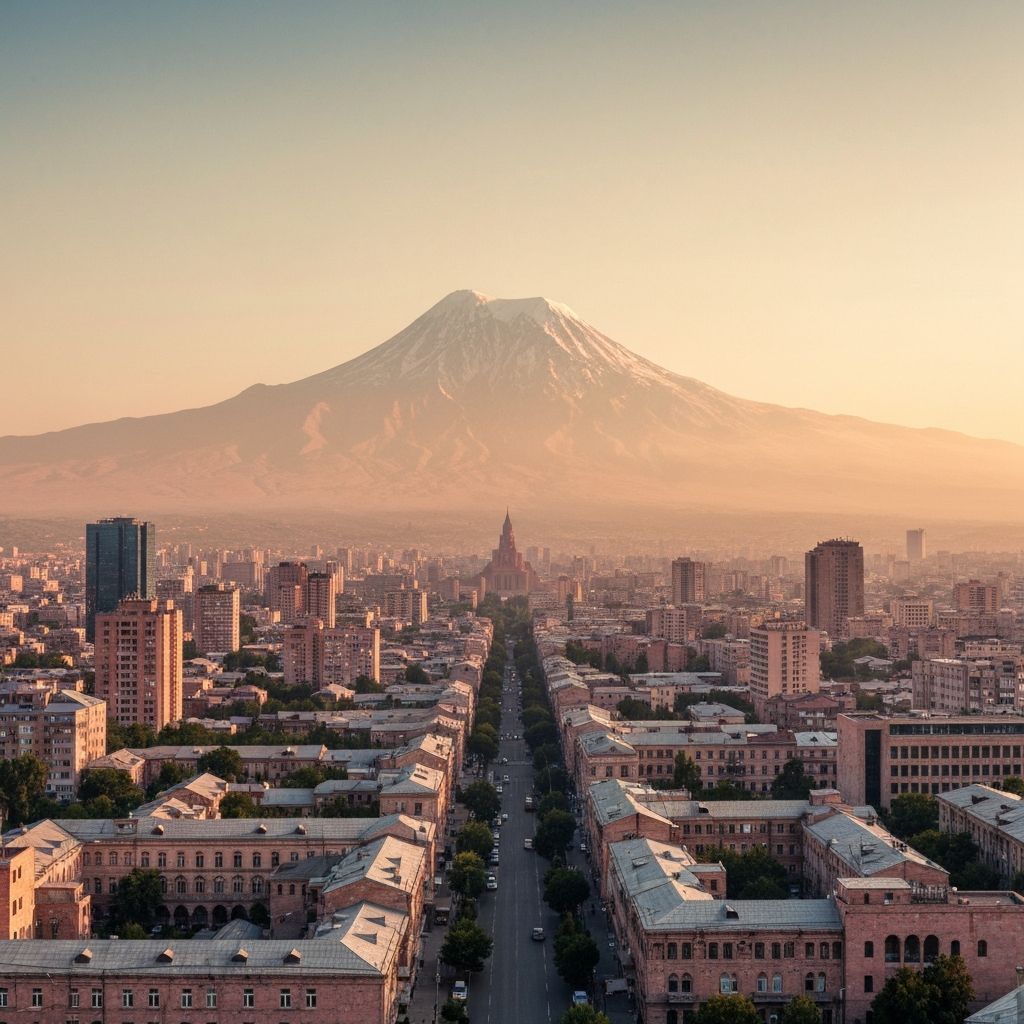
The first thing to know is the dates. Yerevan was founded in 782 BC, on the shore of an Urartian fortress called Erebuni. Rome was founded in 753 BC. The difference is twenty-nine years.
This is rarely the most useful fact about the city. It will not help you open a bank account, register a company, or find an apartment in the Center district. But it does something quieter, and over time, more important. It rearranges your sense of where you have arrived.
Most people who land in Yerevan for the first time arrive with a small mental file labeled "small post-Soviet country." The file empties out, slowly, in about a week.
Three Layers, All Visible
Yerevan is one of the rare cities that wears its layers without trying to. You can stand on Republic Square at dusk and see all three at once.
Underneath everything is the Urartian and pre-Christian layer. Erebuni, the fortress for which the city is named, sits on a hill at the southern edge of the modern center. Its foundations are still readable. The pre-Christian temple at Garni, half an hour outside the city, is older than the Roman buildings most American tourists will compare it to.
Above that is the Soviet layer. The pink-tufa apartment blocks. The grand boulevards. The Cascade. The opera. This is the visual layer most outsiders see first, and it is also the layer that has aged best in the post-Soviet space. The architecture is remarkable: pink, geometric, neither Stalin-grim nor Brezhnev-cheap, with its own quiet confidence.
Above that is the contemporary layer. Cafes that would not feel out of place in Berlin or Lisbon. A startup ecosystem that has, in the last five years, gone from "promising" to "actively recruiting." A diaspora returning. New restaurants opening every month. International schools planning second campuses.
You walk past all three on the way to your morning espresso.
The Christianity Is Older Too
Armenia was the first state in the world to adopt Christianity, in 301 AD, twelve years before the Edict of Milan. The cathedral at Etchmiadzin, twenty kilometers west of Yerevan, is the oldest state-built cathedral in the world.
This is unusual to walk into for the first time. The building has been there for one thousand seven hundred years. The liturgy inside is sung in Old Armenian, a language closer to the language Mesrop Mashtots designed in the fifth century than to anything spoken in the city today. The acoustics are not a metaphor; they are the thing itself.
What is striking is not the antiquity. It is the sense that the antiquity is not on display. People come on Sunday to attend the service. There is no admission fee. The candles are not for tourists.
The Food Is Its Own Argument
A short list of things you will eat in your first month, in the order in which you will probably encounter them: dolma, khorovats, lavash, manti, gata, basturma, sujukh, harissa, and on a quiet evening with the right host, an apricot eau-de-vie that tastes nothing like the apricot brandy you have had elsewhere.
The Ararat valley grows what the locals will tell you, with no irony, are the world's best apricots. The trout from Lake Sevan is on every serious menu. The pomegranate, which you have probably had as a juice at a Whole Foods, is here a national symbol with the seriousness Italy gives the olive.
Eating in Yerevan re-tunes your palate over a few weeks. Most of what you ate before begins to taste a little less alive.
The Languages Stack
Most educated Armenians under forty switch among Armenian, Russian, and English with no friction. Many also have Persian or French. Conversations in cafes, especially the ones near the universities or the ministries, code-switch fluently across two or three languages per minute.
This is interesting if you arrive carrying one. The city assumes, in a way that is hard to describe in writing, that you are also probably carrying more than one. The architecture of the conversation already has room for you.
Why This Matters
If you are reading this because you are thinking about moving to Armenia (and you are, otherwise you would not have made it this far), here is the practical implication. The cultural baseline is higher than the popular image suggests, in the directions that matter for daily life: the food, the architecture, the music, the depth of the multilingual conversation, the felt antiquity, the felt openness to outsiders who arrive with skill and ambition.
This is not the loudest sales pitch for relocation. It is the one we keep finding ourselves making, six months in, when the founders we work with start sending us photos of their apartments at golden hour.
The dates are the least of it. But the dates are also where it starts.
Cross with us. armeniabridge.com